
Low Water Pressure Repair in Rockford, IL
Get a free quote
A licensed plumber replies with a price. Nothing is booked until you say yes.
Pressure problems come in two kinds. Low pressure means a weak shower, slow fill at the washer or a trickle at one faucet. High pressure means banging pipes, a relief valve that drips, a toilet that keeps running or fixtures that wear out early. Both are measured, not guessed. We put a gauge on a hose connection and read the number before we recommend anything. An Illinois-licensed plumber does the work.
Test your water pressure first
A screw-on pressure gauge from a hardware store reads static pressure at an outdoor faucet or a laundry tub connection. Read it when nothing in the house is running. The number tells us which way to go.
| Gauge reading | What it suggests | What we check |
|---|---|---|
| Near zero | The main valve is closed, the service is frozen or the water is off | Main valve, meter valve, city outage |
| Low, and low at every tap | A partly closed valve, a failing regulator or a restricted service line | Main shutoff, regulator, the line from the meter |
| Normal at the gauge but weak at one fixture | A clogged aerator, a scaled cartridge or a bad stop valve | That fixture and its supply |
| Normal cold, weak hot | A water heater problem or a clogged hot line | Heater valves, sediment, hot piping |
| Above 80 psi | A failed or missing pressure regulator, or a very high main | The regulator, the thermal expansion setup |
| Reading climbs when no water is running | A failed regulator creeping up, or thermal expansion in a closed system | Regulator, expansion tank, relief valve |
Below are the Illinois rule and the city's own number for a failing system: Rockford issues a boil order any time system pressure falls below 20 psi (City of Rockford Water Division). If your pressure drops on the whole street, it is the city, not your pipes. The boil order guide explains what to do.
What the Illinois Plumbing Code says about pressure
The Illinois Plumbing Code sets the limits (77 Ill. Adm. Code 890.1210). They matter because a house can fail on either side.
| Rule | What it says |
|---|---|
| Minimum service pressure | At least 20 psi constant on the discharge side of the water meter, and at least 8 psi at each fixture or the fixture maker's minimum |
| Maximum pressure, building entrance | If main pressure exceeds 80 psi, a pressure reducing valve and a strainer with a by-pass relief valve go in the water service near the entrance, reducing it to 80 psi or lower |
| Maximum pressure, one fixture | If pressure at a fixture exceeds 80 psi, a pressure reducing valve, gauge and strainer go in the supply to it |
| Outside faucets | Sill cocks and outside hydrants may be left on full main pressure |
In plain words, a house should have no more than 80 psi inside, and a regulator brings the main down when it is higher. If your gauge says 90 or 100 psi and there is no regulator, or the regulator has failed, that is the repair. Nothing in what we found says how much a Rockford house should have between 20 and 80 psi.
What pressure repair costs
These are typical U.S. ranges from national cost guides. They are not quotes, and no local company price is used. The plumber cost page lists other jobs.
| Job | Typical cost | Source |
|---|---|---|
| Pressure regulator (PRV) replacement | $200 to $700 | Angi |
| Regulator replacement, Angi national average | $400 | Angi |
| Regulator replacement, HomeGuide | $300 to $650 | HomeGuide |
| Expansion tank installation | $150 to $450 | Angi |
| Expansion tank, HomeGuide with installation | $300 to $800 | HomeGuide |
The regulator itself is a modest part. The price depends on the valve size, how hard it is to reach and whether the strainer and the unions around it need replacing at the same time. We quote after the gauge reading and a look at the entrance.
Causes of low water pressure
| Cause | How we confirm it | Repair |
|---|---|---|
| A main or meter valve not fully open | Gauge reads low at every tap, valve handle is partly turned | Open it fully, replace a valve that will not open |
| A failing regulator | Low reading after the regulator, normal before it | Replace the regulator |
| Scale and corrosion inside old pipe | Pressure fine at the meter, weak and slowing at the taps | Replace the pipe, see the galvanized pipe guide |
| A leak between the meter and the house | The meter moves with everything off | Leak detection, then repair |
| A clogged aerator or shower head | One fixture low, others normal | Clean or replace |
| A failing stop valve or supply line | One fixture low, the aerator is clean | Replace the valve or line |
| A well pressure tank or switch | Pressure cycles or drops on a private well | Service the tank or switch |
Old pipe is a common reason in an older city. The Census puts the median Rockford home at 1965 built, and 42.5% were built before 1960 (Census ACS 2024). We check what each house has. The galvanized pipe guide and the repiping page explain what scaled steel pipe means. A leak in the line from the meter is a leak detection job, and a failed line is a water line replacement.
A home on a private well gets its pressure from a pressure tank and switch, not the city. The well and septic guide covers the county side.
What high pressure does to fixtures
The Illinois 80 psi limit is there because pressure above it wears the soft parts of every fixture. Faucet washers and cartridges, toilet fill valves, dishwasher and washing machine hoses and water heater connections all work harder at 90 or 100 psi. The first sign is often a toilet that keeps refilling, a faucet that drips soon after a repair, or a washing machine hose that fails early. Each of those is a symptom, and the regulator is the cause.
| Symptom | How pressure causes it | Related page |
|---|---|---|
| Faucet that drips after a new cartridge | High pressure pushes past the seal | Faucet repair |
| Toilet that refills on its own | The fill valve cannot seat against high pressure | Toilet repair |
| Banging when a valve closes | A pressure spike stops moving water hard | Water hammer guide |
| Weeping relief valve on the heater | Pressure rises as the tank heats | Relief valve guide |
The pages for faucet repair and toilet repair cover the fixture side. If the same fixtures keep failing after a repair, test the pressure before you pay for the third one.
High water pressure and the water heater
High pressure is the harder one to see. You feel it as banging pipes, a toilet that runs, a faucet that drips early or a relief valve that weeps. Pressure over 80 psi wears every washer and seal in the house, and it shortens appliance life.
The water heater is where high pressure shows first. A closed system, with a regulator or a check valve at the meter, has nowhere for heated water to expand. Pressure climbs as the tank heats, and the relief valve opens. Illinois puts that relief valve at a 150 psi maximum and 210 degrees Fahrenheit for the temperature side (77 Ill. Adm. Code 890.1230). An expansion tank absorbs the extra volume and keeps the relief valve from doing the job. If your relief valve drips, read the relief valve leaking guide. If your pipes bang when a valve shuts, the water hammer guide explains the shock and the fix. A tank with a failing anode or old age is on the water heater replacement page.
We recommend an expansion tank when the gauge and the setup call for it, and we explain why.
Regulator replacement and permits in Rockford
A like-for-like regulator swap is a repair of a valve in place. Rockford exempts repairing a leaking pipe, valve or fixture from a plumbing permit when no pipe is resized or rearranged (City permit FAQ). Adding a regulator where none existed, or moving the entrance piping, is a different job, and we check with the city office first. The permits guide explains the steps.
What we do on a pressure call
We read static pressure, then read it again with a tap open, which shows whether the supply holds up under flow. We check the main and meter valves, the regulator and strainer, the water heater valves and the fixtures that complain. We tell you the number, the cause and the repair. If the number is fine and the problem is one fixture, we say so and fix that fixture.
How a pressure regulator fails
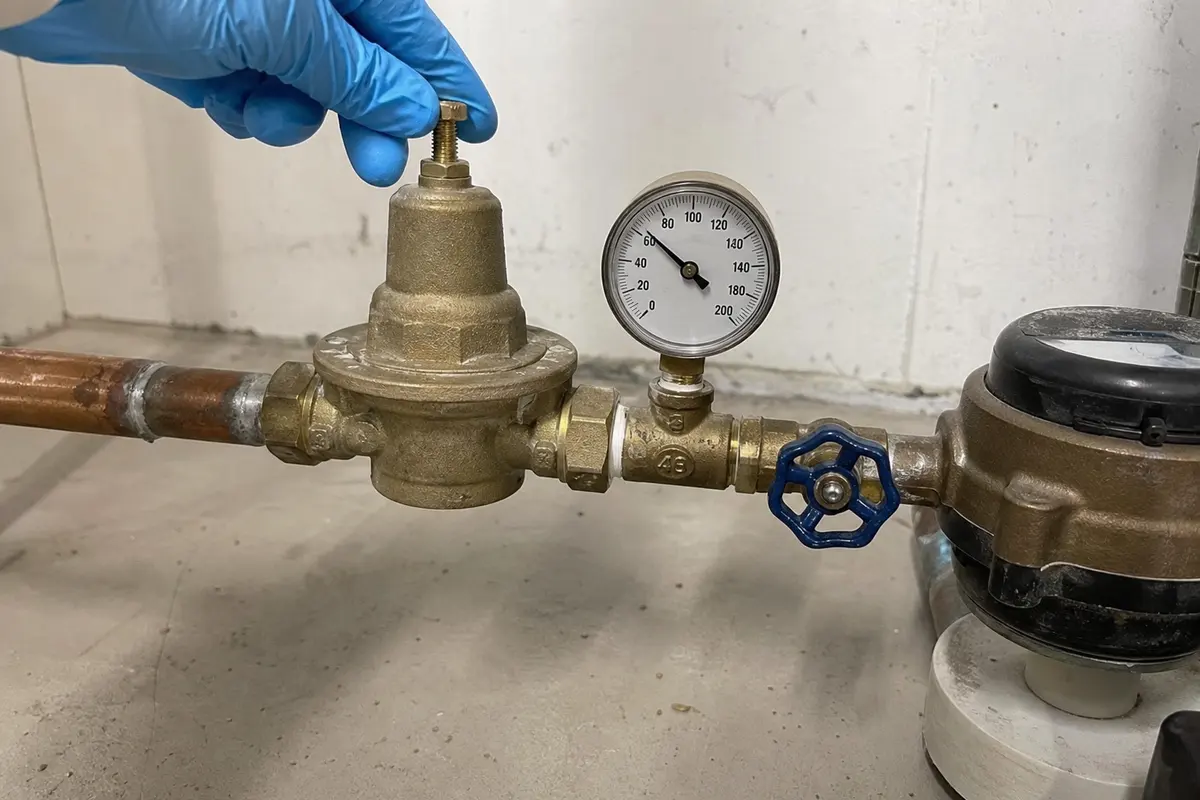
A regulator is a spring and a diaphragm in a bronze body, usually near where the water line enters. Over years the spring loses force, the diaphragm cracks or debris holds the seat open. The signs are a pressure reading that creeps upward overnight, a house that bangs when a valve closes, or a house that suddenly runs weak. A failed regulator can fail high or low.
| Sign | What it suggests | Next step |
|---|---|---|
| Pressure is higher in the morning | The regulator is letting the main through as the house sits | Gauge test, replace the regulator |
| Pressure drops under load | A clogged strainer or a weak spring | Clean the strainer, test flow, replace if needed |
| Water noise at the regulator | A worn seat or loose parts | Replace the regulator |
| No regulator at all, high gauge reading | The house was never fitted with one | Install one, and check the heater and relief valve |
The Illinois rule calls for a strainer with a by-pass relief valve with the regulator, so a replacement visit is also when we clean or replace that strainer. A regulator and strainer are built to be replaced, and the guides above price the swap as a routine job.
Low pressure from the pipes themselves
Pipe that is narrowed by corrosion or mineral scale delivers less water at the same pressure at the meter. The tell is a gauge that reads fine at the entrance and falls hard when a tap opens, and a flow that has been getting worse over years. Rockford water is naturally hard, with hardness listed at 9 to 21 grains per gallon in the city bulletin (City of Rockford Water Division), and scale is one reason old pipe loses capacity. The hardness guide explains it.
A fix for a few bad runs is to replace those runs. A fix for a whole house of choked pipe is a repipe, and we tell you the difference honestly after we measure. We do not recommend a repipe for a pressure problem a regulator or a valve can fix.
After a city main break or a boil order
A main break on your street drops pressure to every house on it. The Water Division says main breaks are rare but more frequent in cold months, and that after a repair air or sediment may discolor the water. Run the kitchen cold tap until it clears, and skip laundry until it does, because the iron will stain clothes (City of Rockford Water Division). If the pressure stays low after the city has finished, or your own fixtures clog with sediment, call us. A sediment-clogged aerator or stop valve is a common aftermath, and we clear it.
A boil order is the city's response when pressure in the system falls below 20 psi. It is the system that is low, not your plumbing, and nothing we do in your house changes it. Follow the order, and once it lifts we can flush the lines and check the water heater if you want us to.
We handle pressure calls in Loves Park, Machesney Park and the rest of the area we serve. Each town has its own water system, and we ask who sends your bill.
Sources (10)
- Angi, water pressure regulator replacement cost
- HomeGuide, water pressure regulator replacement cost
- HomeAdvisor, replace a water pressure regulator
- Angi, installing an expansion tank
- HomeGuide, expansion tank replacement cost
- Illinois Plumbing Code, 77 Ill. Adm. Code 890.1210 (building water distribution system, water pressure)
- Illinois Plumbing Code, 77 Ill. Adm. Code 890.1230 (water heater safety devices)
- City of Rockford Water Division, Boil Orders
- City of Rockford, permit FAQ
- U.S. Census Bureau, ACS 2024 1-year, tables B25034 and B25035 (via Census Reporter)
Where this is done
Water Pressure Repair across Rockford and the cities and villages around it. Each town page covers its own water supplier, sewer and permit office; the full list is on the service area page.
Ready for a price on water pressure repair?
Call, text, or send the form. You get a price back before any work is scheduled.
Water Pressure Repair: questions
How much does it cost to replace a water pressure regulator?
Angi puts it at $200 to $700, averaging $400, and HomeGuide gives $300 to $650. An expansion tank adds $150 to $450. See the cost page.
What is the maximum water pressure allowed in Illinois?
The Illinois Plumbing Code requires a pressure reducing valve when main pressure exceeds 80 psi, to bring the house to 80 psi or lower. The rule is in 77 Ill. Adm. Code 890.1210. Outside faucets may stay at full main pressure.
What is the minimum water pressure?
The Illinois Plumbing Code asks for at least 20 psi constant on the discharge side of the meter, and at least 8 psi at each fixture. Rockford issues a boil order when system pressure falls below 20 psi.
Why is my water pressure low in the whole house?
Common causes are a partly closed main valve, a failing regulator, scaled pipe and a leak between the meter and the house. A gauge reading and a meter test separate them.
Why is the pressure low at only one faucet?
A clogged aerator or a scaled cartridge, most of the time. If the aerator is clean, the stop valve or supply line is next. The faucet repair page covers it.
How do I check water pressure at home?
Screw a pressure gauge onto an outdoor faucet or a laundry tub connection with nothing running and read it. Read it again with a tap open to see how it holds under flow.
Can high water pressure damage my plumbing?
Pressure over 80 psi wears washers, valves and appliance parts, and can cause banging pipes and a dripping relief valve. The fix is a regulator and, on a closed system, an expansion tank.
Is low pressure a city problem or mine?
If the whole street is low, it is the city, so call the Water Division at 779-348-7300. See the boil order guide. If the gauge is fine at the meter and low inside, the cause is in the house.
Other services
Water Pressure Repair: get a written price
Send the job, the town and a rough size. A licensed plumber replies with a price, and no work starts until you agree to it.
Prices and the full service list are on the homepage for a plumber in Rockford.