
Whole-House Repiping in Rockford, IL
Get a free quote
A licensed plumber replies with a price. Nothing is booked until you say yes.
Updated
Short answer
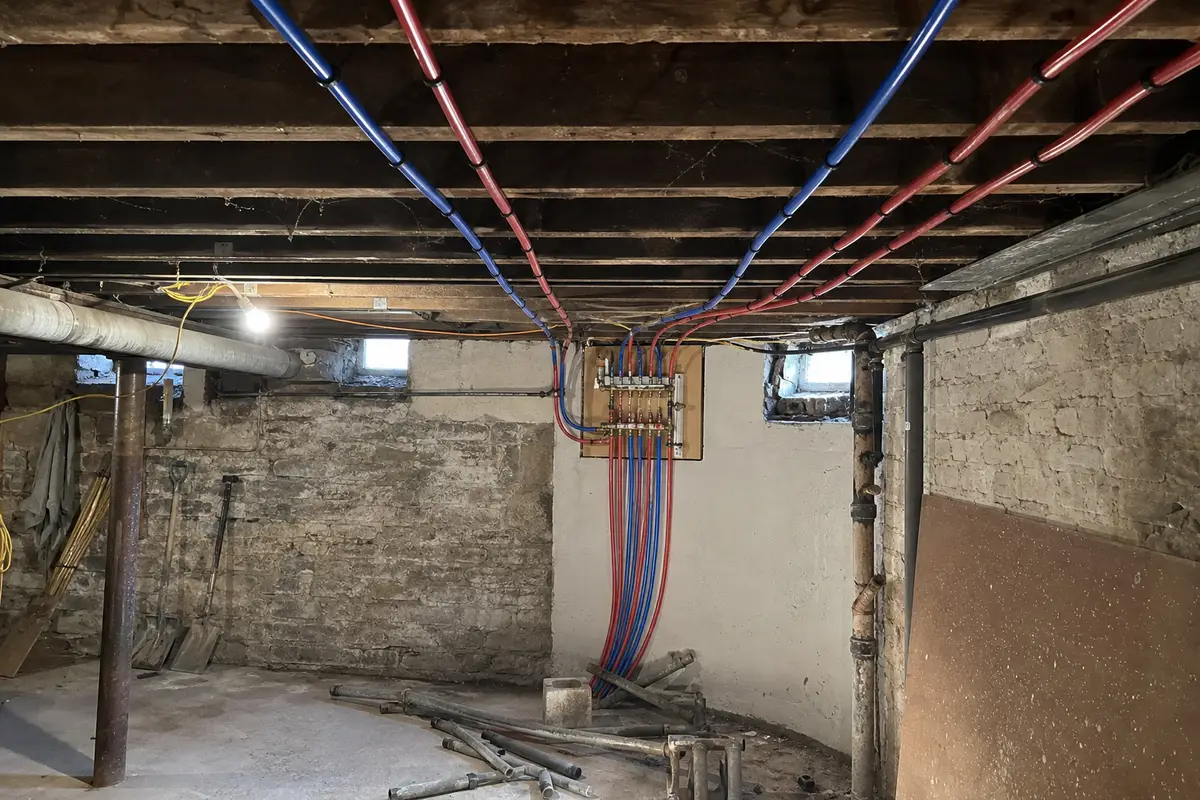
A repipe replaces the water supply pipes inside your house: the lines that carry hot and cold water to every sink, tub, toilet and appliance. It is a big job, so it only makes sense when the old pipe is failing across the house and not at one spot. This page covers when a house needs it, how PEX and copper compare, what a repipe costs, and the Rockford permit rules that apply. Rockford has a lot of older housing, which is why this comes up here more than in a newer town.
Why older Rockford homes get repiped
The Census Bureau puts Rockford's median home at 1965, with 64,380 housing units in the city. 20.1% of them, 12,950 homes, were built in 1939 or earlier, and roughly 42.5% predate 1960 (Census ACS 2024). Winnebago County is newer, with a median of 1972, but 32% of county homes are still pre-1960. These are estimates with margins of error, and the census does not say what pipe is inside the walls.
What the city does say is useful. Rockford's own water report says its lead service lines were mostly installed before 1960 (2025 water quality report), and the local plumbing amendment bans galvanized steel for water service pipe (Ord. 2024-174-O). Galvanized is steel pipe with a zinc coat, and it corrodes from the inside over decades. That is why a house of that age is the usual candidate. The details are in galvanized pipes in older homes.
Signs your house needs a repipe
- Water pressure that is weak at several fixtures and does not improve when one valve is replaced.
- Brown, orange or rusty water, especially first thing in the morning, that clears after a minute.
- Repeated pinhole leaks or a second leak in a different spot within a few years.
- Visible rust, flaking or green crust on pipes in the basement or under sinks.
- A buried service line that was replaced but the pressure inside the house stayed low.
One leak is not a repipe. A single failed joint or a frozen section is a repair, and frozen pipe repair or leak detection covers it. When leaks keep arriving in different places, the pipe itself is the problem. Rust also shows up from sediment in the system: the city says iron and manganese from its water can discolor it after hydrant flushing or a main break (City Water Division), so rust after a street event does not by itself mean your pipes are bad.
What a repipe costs
Rockford plumbers do not publish prices, so these are typical U.S. ranges from national 2026 cost guides, not quotes. The plumber cost page compares every job.
| Job | Typical cost | Source |
|---|---|---|
| Whole-house repipe | $1,500 to $15,000 | Angi |
| Typical whole-house repipe | About $7,500 | Bob Vila |
| PEX pipe, material only | $0.40 to $2 per linear foot | Angi |
| Copper pipe, material only | $2 to $8 per linear foot | Angi |
| Main water line, street to house | $2,000 to $5,000 | HomeGuide |
The pipe is the smaller part of the bill. A repipe means opening walls and ceilings, running new lines, closing everything back up and testing it. The size of the house, the number of bathrooms, whether there is a basement or crawl space to run pipe through and how much drywall comes off decide the total. A one-story ranch with a basement is cheaper to repipe than a two-story with a slab. Many jobs are split into stages, such as the basement mains first and the upper floors later, so a repipe can be planned around the budget.
PEX or copper
| PEX | Copper | |
|---|---|---|
| Material cost, per linear foot | $0.40 to $2 per linear foot | $2 to $8 per linear foot |
| How it goes in | Flexible tubing that bends around corners, fewer joints | Rigid pipe joined at each fitting |
| Disruption in walls | Less cutting in most houses, because it snakes through | More cutting and more joints |
| Where it suits | Most whole-house repipes where cost and fewer wall openings matter | Exposed runs and jobs where the owner wants metal |
Both work. PEX is cheaper in material and faster to run, which is why it is common in repipes. Copper costs more and takes longer, and some owners prefer it for exposed pipe and a metal service. Copper is also what the city specifies for the buried service (Type K soft copper for services 2 inches and smaller), so the service and the house piping can be different materials and still be correct. We confirm the material against the 2014 IDPH Illinois Plumbing Code and the Rockford amendments before we order pipe, and we explain the tradeoff on your house before you decide.
Whole-house or partial repipe
| Whole-house repipe | Partial repipe | |
|---|---|---|
| What it covers | Every hot and cold supply line from the service to each fixture | One section, such as the basement mains, one bathroom or one wing |
| Best when | Pipes are failing across the house and leaks keep arriving in new places | Part of the pipe is bad and the rest tests sound |
| Cost | $1,500 to $15,000 | Lower, depending on the section |
| Disruption | Most wall openings, done once | Fewer openings now, more later if the rest fails |
| Risk | Highest upfront cost | Mixed old and new pipe, and a second job later |
A mix of old and new pipe can work, but two metals in one system can corrode at the joint where they meet, so we use the proper fittings and tell you where they are. If the house has galvanized pipe throughout, a partial repipe usually delays the real job. If only one run is bad, it is a fair choice. We give you the whole-house number and the partial number side by side so you can compare.
Pressure, the regulator and the water heater
New pipe is a good time to check the parts around it. A pressure regulator that has drifted can leave a house with pressure that is too high or too low. National guides put a pressure regulator replacement at $200 to $700 (Angi). The water heater connections and any expansion tank get checked at the same time, and a failing heater is a separate decision, covered under water heater replacement. The city says to flush a water heater at least once a year to clear sediment such as iron, manganese and calcium (City of Rockford), and a new system starts with a clean heater.
What to expect inside the house
- Access holes in drywall or plaster at the points where new pipe has to pass through framing.
- Water off while we cut over, and a flush of the new lines when the water comes back on.
- Air in the lines for a short while, which shows up as sputtering at the faucets until it clears.
- Furniture and floors protected in the work areas, and a daily cleanup.
- A final pressure test before the walls are patched, so a leak shows up while the wall is still open.
Hiring for a repipe
A repipe is a large job that touches every room, so compare scopes and not only totals. Ask for the number of fixtures, the pipe material, how many access holes, who patches them and whether the permit and inspection are in the price. Illinois requires anyone who plans, installs, alters, extends, repairs or maintains plumbing systems to be licensed by IDPH (IDPH Plumbing), and a licensed plumber does the work in a Rockford repipe. Hourly pricing is in the plumber hourly rate guide.
How to tell what pipe you have
The city's guide for finding a lead service line uses three things: a flathead screwdriver, a refrigerator magnet and a coin. It tells you to check the pipe between where it enters the building and the inlet valve, usually in the basement, and to scratch through the corrosion first (2025 water quality report). Lead is soft and scratches shiny silver. Copper is copper-colored. Galvanized steel holds a magnet. The same test works on the pipes inside the house, and it takes two minutes. Take a photo of the pipe and the scratch mark before you call so we can see what you see.
If the pipe at the wall is copper and the rest of the house is galvanized, the house was probably partly repiped long ago. If everything you scratch is galvanized, you are looking at the full-house case. This is the basis of the quote, so we ask for it first.
Repiping and the lead service line
A new house piping system does not fix a lead service line. If the line from the street into your house is lead or galvanized, the water still passes through it. Check the service when you repipe. Illinois law prohibits partial lead service line replacements when a water system does the work, so if your line is lead, plan the whole replacement. See water line replacement and the lead service lines guide. The city's lead line map shows what it has on record for your address, and free lead testing is available from Water Quality at 779-348-7151.
Rockford permit and inspection rules for a repipe
Rockford requires a plumbing permit to install, alter, repair, remove, convert or replace plumbing systems, equipment, appliances or fixtures (City of Rockford permits). A repipe changes the plumbing system, so it needs a permit and an inspection. The exemptions the city lists are for stopping a leak or clearing a stoppage where no pipe is resized or rearranged (City permit FAQ). Running new lines is neither of those.
The plumbing code the city enforces is the 2014 IDPH Illinois Plumbing Code, as amended by Ordinance 2024-174-O, effective January 1, 2025. Under the city's local amendment the permit application has to come from a State of Illinois plumbing license holder, with an exception for the owner-occupant of a single-family home. An owner-occupant can do plumbing in their own home, but any helper must be a licensed plumber (Illinois Plumbing License Law). A repipe is not a small job to learn on. The permits guide and the owner exemption guide cover where the lines are, and you can verify a plumber with the license check guide.
How a repipe goes
- We walk the house, trace the supply from the meter to every fixture and identify the pipe material.
- We give you a written scope with the material, the number of fixtures and where walls will open.
- The permit is pulled by a licensed plumber and the water is shut off only for the cutover.
- We run the new lines, connect fixtures and pressure test before the walls close.
- The city inspects, then we patch access openings and restore water.
Expect drywall patches that will need paint. We tell you where the openings will be before we start, and we keep them as small as the layout allows.
Repiping in nearby towns
We repipe in Loves Park, Machesney Park, Rockton and the rest of the service area. Rockton and South Beloit have galvanized service lines scheduled for replacement, so a repipe there is worth timing with the service. Homes on a private well have a different supply, which the well and septic guide covers.
Sources (11)
- Angi, cost to repipe a house
- Bob Vila, cost to repipe a house
- HomeGuide, water line replacement cost
- U.S. Census Bureau, ACS 2024 1-year, tables B25034 and B25035 (via Census Reporter)
- City of Rockford, 2025 Consumer Confidence Report
- City of Rockford, local amendments to the 2014 IDPH Illinois Plumbing Code (Ordinance 2024-174-O)
- City of Rockford, Mechanical and Plumbing Permits
- City of Rockford, permit FAQ
- Illinois Plumbing License Law (225 ILCS 320)
- City of Rockford Water Division, Iron and Manganese
- City of Rockford, Water Distribution System Design and Specifications
Where this is done
Repiping across Rockford and the cities and villages around it. Each town page covers its own water supplier, sewer and permit office; the full list is on the service area page.
Ready for a price on repiping?
Call, text, or send the form. You get a price back before any work is scheduled.
Repiping: questions
How much does it cost to repipe a house?
National 2026 guides put a whole-house repipe at $1,500 to $15,000, with $7,500 as the typical figure. The wide range comes from house size, pipe material and how much wall has to open. See the cost page for how these ranges are used.
How do I know if my house has galvanized pipes?
Galvanized pipe is gray steel that corrodes from the inside and holds a magnet. Check the pipe in the basement or under a sink. Rockford bans it for water service pipe, but many older homes still have some inside. Read the galvanized pipe guide.
Is PEX or copper better for repiping?
PEX material runs $0.40 to $2 per linear foot and copper $2 to $8 per linear foot, and PEX is faster to run with fewer wall openings. Copper costs more and some owners prefer it for exposed pipe. We confirm the material against the Illinois plumbing code and Rockford's amendments.
Do I need a permit to repipe in Rockford?
Rockford requires a plumbing permit to alter or replace plumbing systems, and a repipe does both. The permit application must come from a State of Illinois plumbing license holder, with an exception for the owner-occupant of a single-family home. See the permits guide.
How long does a repipe take?
It depends on the house. A small home with open basement access goes faster than a two-story house with finished walls. We give you a schedule after we walk the house, and the water is off only while we connect over.
Will repiping fix low water pressure?
It fixes low pressure that comes from corroded pipes inside the house. It does not fix a low-pressure main or a failing buried service. We trace the pressure from the street in first, so you pay for the right job. See water line replacement.
Can I repipe only part of the house?
Many jobs are done in stages, such as the basement mains first and the upper floors later. A partial repipe works when the remaining pipe is in good shape. A lead or galvanized service line is a separate job and should be planned with it.
Does a repipe get rid of lead in my water?
Only if the lead came from the house piping or solder. A lead service line from the street keeps contributing lead until it is replaced. Rockford says lead is not in its groundwater, so the source is lines and corrosion. See Rockford's lead service lines.
Other services
Repiping: get a written price
Send the job, the town and a rough size. A licensed plumber replies with a price, and no work starts until you agree to it.
Prices and the full service list are on the homepage for a plumber in Rockford.