Sewer Line Repair in Rockford, IL
Get a free quote
A licensed plumber replies with a price. Nothing is booked until you say yes.
A broken sewer line shows up as slow drains in the whole house, a sewage smell in the basement, a wet patch in the lawn, a floor drain that backs up or a clog that returns a few weeks after every cleaning. We start with a camera. It shows the pipe material, the break or the roots, how far from the house it is and whether the line has bellied. Then we tell you whether a spot repair, a section replacement, a liner or a full dig is the right job. If the camera finds nothing, you have paid for a camera and not a repair.
Roots, age and ground movement are the usual causes. Start with the drain cleaning page if the line may only be clogged, and read the sewer backup guide if water is already coming up.
What sewer line repair costs in Rockford
These are typical U.S. ranges from national guides. They are not Rockford quotes, and no local company price is used. Depth, length, the surface above the pipe and how many feet are involved move the number more than anything else. The quote page takes a camera screenshot or a photo, and the plumber cost page has the rest of our prices.
| Job | Typical cost | Source |
|---|---|---|
| Camera inspection | $125 to $500 | HomeGuide |
| Spot or partial repair | $2,500 to $4,000 | Modernize |
| Spot repair, widest range by method | $150 to $3,800 | HomeGuide |
| Full replacement, whole job | $3,000 to $7,000 | Modernize |
| Full replacement, per foot | $50 to $250 per linear foot | This Old House |
| Trenchless lining (CIPP), per foot | $135 to $150 per linear foot | Angi |
| Trenchless pipe bursting, per foot | $150 to $190 per linear foot | Angi |
Angi puts a whole lining job at $1,900 to $6,000, typically $2,900. This Old House says most people pay $1,390 to $5,320 for replacement, with an average of $3,320, and HomeGuide shows $2,000 to $10,000 for a 40 foot run. The low end is a short line in open ground. The high end is a long line, a deep line, one that runs under concrete or a driveway, or one that needs a street connection reworked. Ask for the footage and the method in writing.
Signs your sewer line has a problem
| Sign | What it can mean | What we do |
|---|---|---|
| Several drains slow or gurgling together | A partial blockage or a damaged main line | Check the manhole, then camera the line |
| Sewage smell inside or outside | A broken pipe, a dry trap or a vent problem | Camera and smoke or dye as needed |
| Wet, green or sunken patch in the yard | A leaking or collapsed line under the lawn | Camera from the cleanout, then locate |
| Floor drain backs up when the washer drains | A restriction in the lateral | Cable it, then camera |
| Clogs return after each cleaning | Roots, a belly or a broken joint | Camera, then repair or line |
| Foundation cracks or sinking near the line | Washed-out soil from a leaking pipe | Camera and locate the break |
A camera inspection usually answers the first question in an hour. Ask for a copy of the footage with the footage stamped at the break, because you will want it if you sell, file an insurance claim or ask FRSA to repair a break in the right-of-way.
How a sewer repair job runs
| Stage | What happens |
|---|---|
| Camera and locate | We run a camera from the cleanout, mark the break and measure how far it is from the house |
| Quote and method | You get the method, the footage and the price in writing, and we explain what the city or FRSA needs |
| Permit | We pull the permit that applies, a plumbing permit for lining, the FRSA permit for service work, before anyone digs or lines |
| Call before you dig | Utility locates are requested so we do not hit a gas, electric or water line |
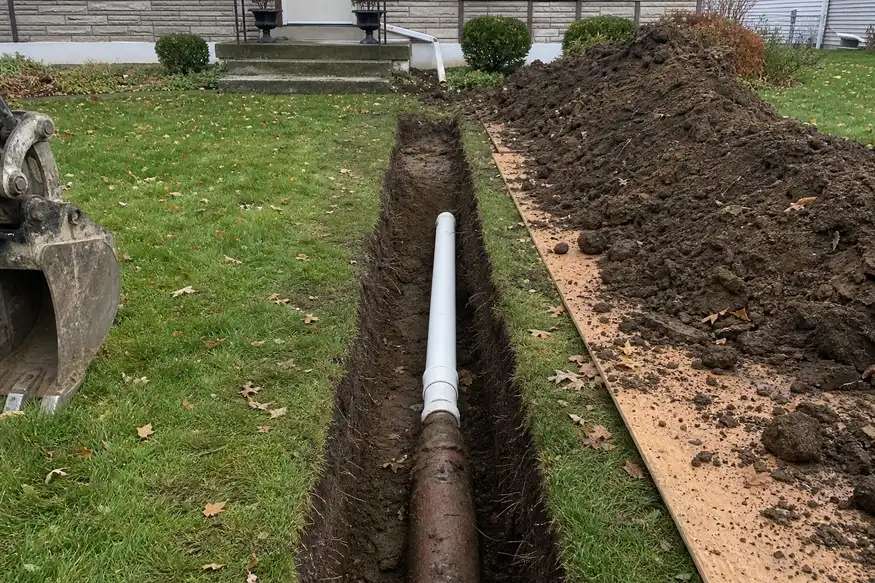
| Repair | Spot dig, trench, bursting or lining, with the pipe graded so it drains |
| Test and inspect | We camera the new pipe, and the city or FRSA inspects when required |
| Restore | Backfill, compaction and a patch of lawn or paving where we opened it |
The one item we cannot hurry is the permit and inspection step. If FRSA or the city requires an inspection before the trench is backfilled, the pipe stays open until the inspector signs off. The process page shows how we schedule around it.
Questions to ask any sewer contractor
Sewer work is a big bill, and the questions are the same whoever you hire. Is the contractor an Illinois-licensed plumbing contractor, and can you confirm it on the state lookup the license check guide links? Are they registered and bonded with FRSA for sewer service work? Who pulls the permit, and is it in the contractor's name? Does the quote name the method, the footage and whether the cleanout is included? What happens if the camera shows a different line than expected? A contractor who cannot answer these is not ready to dig up your yard.
Illinois plumbing contractors carry a $20,000 bond or letter of credit and insurance with at least $100,000 per occurrence, $300,000 aggregate, workers comp with $500,000 employer's liability (225 ILCS 320). You can ask any contractor for the certificate.
Spot repair, replacement, lining or bursting
| Method | How it works | When it fits |
|---|---|---|
| Spot repair | Dig to the break, cut out the bad section and join new pipe | One break or one root-damaged joint, with the rest of the line sound |
| Full replacement | Open trench, new pipe the whole way from the house to the main | Collapsed, bellied or badly offset pipe, or several breaks |
| Trenchless lining (CIPP) | A resin liner is cured inside the old pipe, forming a pipe within a pipe | A sound pipe with cracks or root entry and no major offset or collapse |
| Pipe bursting | A head pulls new pipe through and breaks the old pipe outward | A line that needs full replacement without a long trench |
Trenchless methods spare the lawn and driveway, but they only suit some lines. A collapsed or heavily offset pipe cannot be lined, and the city may refuse a liner on a line it wants dug up. The method follows what the camera shows. We will say plainly when digging is the better repair.
Rockford rules for relining a sewer line
Rockford's local plumbing amendment, Ordinance 2024-174-O, took effect January 1, 2025. It says relining a sewer (CIPP or epoxy) needs a permit and GPS-stamped camera footage. The application goes in with the plumbing permit, and the footage is for the city plumbing inspector. The liner has to cover the lateral run in its entirety, and the city may require the old pipe to be dug up and replaced instead (City of Rockford amendments). Any lining estimate that skips this step is not a complete estimate.
The same amendment sets cleanout spacing in horizontal drains of 4 inches or less at no more than 50 feet, and bars ABS for the building drain, vent and building sewer. During a sewer job we add a cleanout where the line has none, which makes the next camera visit cheap. See the Rockford plumbing permits guide for how permits work.
Who owns the sewer line in Rockford
The owner. Four Rivers Sanitation Authority, formerly the Rock River Water Reclamation District, maintains the main sewer lines only. The line from the house to the main is the property owner's to maintain and repair, including roots and debris (FRSA FAQs). State law ends the building drain 5 feet beyond the foundation walls, where the building sewer begins and runs to the public sewer (225 ILCS 320). If the main is flowing and your line is the problem, repair and cleaning are your cost.
There is one break in your favor. If a licensed plumber reports that a sewer service needs repair inside the right-of-way, FRSA repairs that part at no cost to the owner, with timing set by impact and backlog (FRSA FAQs). We report it when the camera shows the break past the property line. The sewer line ownership guide walks through the split with examples.
Four Rivers registration and permits for sewer work
Sanitary sewer service work in Rockford is not open to anyone with a shovel. FRSA says anyone doing sanitary sewer service construction, connection or disconnection must be a State of Illinois licensed plumbing contractor doing work by a licensed plumber, registered and bonded with FRSA. Registration is a precondition to getting permits, and it expires each May 31 (FRSA Code of Ordinances). Before any service construction or demolition, the contractor gets the FRSA permit and pays the applicable fees.
FRSA also splits registrations by where the work happens. A private property registration covers permitted sewer service work on private property only. Work in the public right-of-way or a sewer easement needs a public property or sewer contractor registration, and a licensed plumber must be in responsible charge on site. A registered contractor who works without a valid permit loses the registration. FRSA fees depend on the job, so we confirm the current fee with FRSA before we quote.
A homeowner may do plumbing in their own single-family home under state law, but the FRSA rules for sewer service work apply to contractors, and we do not recommend digging your own sewer line. The homeowner plumbing guide explains the exemption.
Clearwater inspection before you sell
FRSA code says no one may sell, transfer or convey a building served by its sewer until a current certification of compliance is on file with FRSA. The owner hires a State of Illinois licensed plumber to complete the Clearwater Inspection Form. The visit takes 15 to 20 minutes, and the form is valid for one year (FRSA FAQs and FRSA Code).
The form asks the plumber to mark roof drains, foundation drains, sump pumps, diverter valves and similar connections that send clear water to the sanitary sewer (Clearwater form). Sump pumps must not discharge to the sanitary sewer. If the form fails, FRSA gives 30 days to fix an illegal roof or foundation drain, sump pump or diverter valve, and 60 days for clear water entering through an under-the-floor connection. The clearwater inspection guide covers the form line by line. A camera run on the sewer line before listing finds a problem while you can still fix it on your own schedule.
What moves the price of a sewer job
| Factor | Raises the price when | Lowers it when |
|---|---|---|
| Length | The break is far from the house or the line is long | The break is near the cleanout |
| Depth | The pipe is deep and the trench needs shoring | The pipe is shallow |
| Surface | The line runs under concrete, a driveway, a deck or landscaping | The line runs under open lawn |
| Pipe condition | The pipe is collapsed, offset or has many breaks | One break and sound pipe on both sides |
| Access | There is no cleanout and the line must be opened to run a camera | A clean cleanout reaches the line |
| Method | Open trench with a long restoration | Lining or bursting where the pipe allows it |
This is why two quotes can differ by thousands of dollars for the same address, and why the quote has to say the footage and the method. If a number comes without a camera look, ask what it is based on.
Sewer rules in nearby towns
Outside the FRSA service area, the village or the county sets the rule, and not every town runs on the same system. A few examples from documents we could read.
| Town | What it publishes | Source |
|---|---|---|
| Rockton | Its own Clearwater Inspection Form and a Water and Sewer Permit | Rockton form |
| Belvidere | A plumbing permit is required to install, alter, replace or remove plumbing (Sec. 22-313), and a water or sewer service installation fee of $50.00 in the code, confirm the current amount | Belvidere code |
We confirm the rule for your address before we quote, because a sewer job in one town can need a permit that the next town does not ask for.
Sewer problems in older Rockford housing
20.1% of Rockford homes, 12,950 units, were built before 1940, and the median home dates from 1965 (Census ACS 2024). The camera tells us what your lateral is made of. Outside the city, a home on a septic system has no FRSA lateral at all, and Winnebago County rules apply; see the well and septic guide.
We repair sewer lines in Loves Park, Cherry Valley and Belvidere as well. Each town has its own sewer rules, and we check them before we price.
Sources (14)
- Modernize, sewer line repair and replacement cost
- HomeGuide, sewer line repair cost
- This Old House, sewer line replacement cost
- Angi, sewer line replacement or repair cost
- HomeAdvisor, repair a sewer main
- Angi, trenchless sewer line replacement cost
- HomeGuide, sewer camera inspection cost
- Four Rivers Sanitation Authority, FAQs
- Four Rivers Sanitation Authority, homeowner tips
- Four Rivers Sanitation Authority, Code of Ordinances
- Four Rivers Sanitation Authority, Clearwater Inspection Form
- City of Rockford, local amendments to the 2014 IDPH Illinois Plumbing Code (Ordinance 2024-174-O)
- Illinois Plumbing License Law (225 ILCS 320)
- U.S. Census Bureau, ACS 2024 1-year, tables B25034 and B25035 (via Census Reporter)
Where this is done
Sewer Line Repair across Rockford and the cities and villages around it. Each town page covers its own water supplier, sewer and permit office; the full list is on the service area page.
Ready for a price on sewer line repair?
Call, text, or send the form. You get a price back before any work is scheduled.
Sewer Line Repair: questions
How much does sewer line repair cost in Rockford?
National guides put a spot repair at $2,500 to $4,000 and a full replacement at $3,000 to $7,000, or $50 to $250 per linear foot. See the cost page.
Who owns the sewer line from my house to the street?
You do. Four Rivers maintains the main lines only, and the owner maintains the line from the house to the main. If a licensed plumber reports a break inside the right-of-way, FRSA repairs that part free. See the ownership guide.
Does Rockford require a permit to reline a sewer?
Yes. The city says relining a sewer (CIPP or epoxy) needs a permit and GPS-stamped camera footage. The liner must cover the lateral run in its entirety, and the city may require the pipe to be dug up and replaced instead.
Can any plumber repair a sewer service in Rockford?
Four Rivers requires sewer service work to be done by a State of Illinois licensed plumbing contractor registered and bonded with FRSA, with an FRSA permit before the work starts. Registration expires each May 31.
Do I need a sewer inspection to sell my house in Rockford?
You need a Clearwater Inspection by a licensed plumber. The visit takes 15 to 20 minutes, and the form is valid for one year. See the clearwater inspection guide.
What is the difference between pipe lining and pipe bursting?
Lining cures a resin liner inside the old pipe. Bursting pulls a new pipe through and breaks the old one outward. Lining needs a pipe that is still in one piece, and bursting suits a line that needs full replacement without a long trench.
How do I know if my sewer line is broken?
Common signs are slow drains throughout the house, gurgling, sewage smells, wet spots in the yard and clogs that return soon after cleaning. A camera inspection confirms it. Start with the drain cleaning page.
Will homeowners insurance pay for a sewer line repair?
Coverage depends on your policy and the cause of the damage. Ask your insurer before work starts, and keep the camera footage and photos.
Other services
Sewer Line Repair: get a written price
Send the job, the town and a rough size. A licensed plumber replies with a price, and no work starts until you agree to it.
Prices and the full service list are on the homepage for a plumber in Rockford.